
Vinyl plank flooring has become one of the most popular choices for modern apartments in Dubai, offering a balance of style, practicality, and cost efficiency. Among the key factors that influence its performance, thickness plays a critical role in shaping how the floor feels underfoot, how it handles sound, and how long it lasts in daily use.
In high-rise residential environments, where noise transfer between units is a common concern, plank thickness can significantly affect acoustic comfort by reducing impact sound and improving overall insulation. It also contributes to the perceived solidity of the flooring, making thinner or thicker options feel noticeably different when walking across them.
From a durability standpoint, thickness often correlates with resistance to wear, dents, and subfloor imperfections, which are especially important in busy Dubai apartments with frequent foot traffic. Understanding how vinyl plank thickness impacts these three key aspects helps homeowners make more informed decisions that match both lifestyle needs and building conditions.
Comparing 3mm, 5mm, and 8mm vinyl for footfall comfort
Vinyl thickness influences comfort, but the “feel” underfoot is mostly a combination of core density (SPC vs WPC), backing layer, and underlayment rather than thickness alone.
- 3mm vinyl: Firmest feel. You’ll sense more of the subfloor, especially on concrete.
- 5mm vinyl: Balanced comfort with improved cushioning and less “hollow” response.
- 8mm vinyl: Most cushioned and stable, especially in floating systems with integrated underlay.
In practical use, the jump from 3mm → 5mm is more noticeable than 5mm → 8mm for comfort.
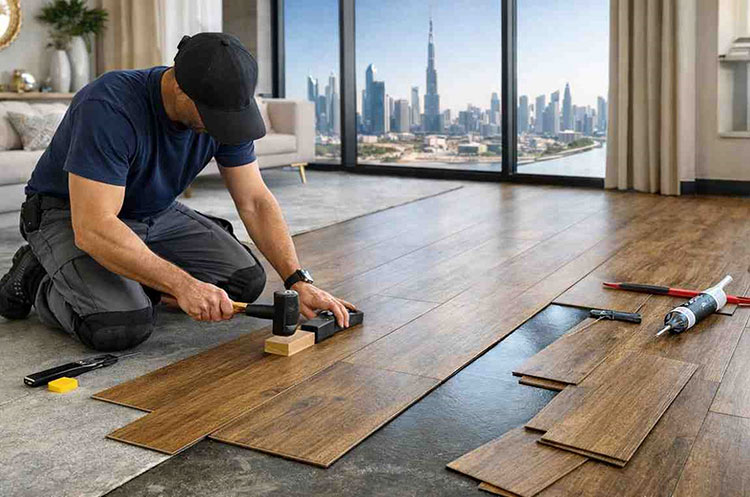
Thickness impact on sound reduction for multi-story buildings
Thickness alone does not determine acoustic performance in high-rise buildings such as those found in Dubai Marina. While a thicker vinyl plank may slightly reduce surface resonance and create a more solid feel underfoot, it does not significantly block impact sound transmission between floors. In real-world applications, the primary factor responsible for noise reduction is the quality and type of underlayment used beneath the flooring.
Acoustic layers such as rubber, high-density foam, or mass-loaded vinyl (MLV) are specifically designed to absorb and dissipate impact energy before it reaches the structural slab. A thicker plank, such as 8mm vinyl, may feel quieter to walk on compared to thinner options, but without an effective acoustic underlayment system, the improvement in sound insulation remains limited. Therefore, thickness should be considered a supportive feature rather than the main solution for acoustic control in residential apartment environments.
Durability correlation: thicker always means longer-lasting?
- Thickness alone does NOT automatically equal higher durability in vinyl flooring systems.
- The wear layer quality is the most critical factor for long-term surface resistance against scratches, stains, and abrasion.
- The core structure matters more than thickness—SPC (Stone Plastic Composite) cores are typically denser and more stable than WPC or low-density foams.
- A strong locking system plays a major role in preventing joint failure, gapping, and movement over time.
- Thickness mainly contributes to impact absorption and comfort, not to scratch resistance or surface wear longevity.
- A high-quality 5mm SPC vinyl plank can outperform an 8mm low-density product in real durability tests and daily use conditions.
- In practice, durability is a combination of engineering quality, not just physical thickness—so specification sheets matter more than millimeters alone.
How thickness affects heat transfer from underfloor cooling systems
Thickness slightly influences thermal responsiveness in vinyl flooring systems, especially in apartments and homes that use chilled slab or underfloor cooling setups common in Dubai. Thinner options, such as 3mm vinyl, allow for faster heat transfer, meaning they respond more quickly to temperature changes and cool down at a faster rate. A 5mm plank typically offers a balanced performance, providing a compromise between responsiveness and underfoot comfort.
On the other hand, 8mm vinyl tends to have slightly slower thermal response due to its increased material density and added thermal resistance, which can delay the rate at which cooling is felt at the surface.
However, in real residential conditions, the difference is often marginal. While thinner floors may offer minor efficiency improvements, overall comfort, acoustic insulation, and structural stability usually play a more important role in user satisfaction than thermal responsiveness alone.
Thickness role in hiding subfloor imperfections in older buildings
Thicker vinyl planks can help visually mask minor subfloor imperfections, but they do not eliminate the need for proper surface preparation or leveling. In thinner options such as 3mm vinyl, even small dips, ridges, or old grout lines are easily telegraphed through the surface, making subfloor flatness extremely critical.
A 5mm plank offers moderate forgiveness, slightly reducing the visibility of minor irregularities while still requiring a well-prepared base. The 8mm vinyl performs best in terms of bridging small imperfections, as its added thickness provides more rigidity and surface stability, which helps reduce minor undulations from showing through.
However, it is important to emphasize that none of these thickness levels can compensate for significant slab defects. Deeper unevenness, cracks, or structural variations still require proper leveling compounds and professional subfloor correction before installation to ensure long-term performance and a visually smooth finish.
Furniture dent resistance across different thickness categories
- Dent resistance in vinyl flooring is primarily determined by core rigidity and load distribution, not thickness alone.
- Thicker rigid-core vinyl can distribute weight more effectively under heavy furniture, reducing localized pressure points.
- However, a thin but high-density core can often outperform a thicker product with a softer or less stable structure.
- If the core material lacks strength, even thicker planks may still develop indentations over time under static loads.
- Heavy furniture such as sofas, beds, and cabinets should always be used with protective pads or load spreaders, regardless of plank thickness.
- Thickness provides some added buffering capacity, but it does not fundamentally change how the core reacts to sustained pressure.
- Overall, dent resistance is a material engineering property first, and a thickness factor second, making core quality the more decisive element.
Installation difficulty differences between thin and thick planks
- 3mm vinyl planks are easy to cut and handle, but they are highly unforgiving when installed over imperfect subfloors, as even minor irregularities can show through.
- 5mm vinyl is generally considered the most installer-friendly option, offering a practical balance between flexibility, stability, and ease of fitting.
- 8mm planks provide greater rigidity and long-term stability, but they are more demanding during installation, requiring more precise cutting and careful locking alignment.
- As thickness increases, planks tend to reduce sensitivity to small subfloor imperfections, improving surface smoothness in some cases.
- However, thicker materials also increase installation difficulty, especially when it comes to accurate joint connection and tight seam fitting.
- Proper installation tools and experience become more important as plank thickness increases to avoid gapping or misalignment.
- Ultimately, thicker vinyl offers stability benefits, but it trades off some ease of handling and precision during fitting.
Thickness impact on door clearance and transition strips
Higher thickness increases finished floor height, which affects:
- Door clearance (may require trimming)
- Appliance fitting under cabinets
- Transition strip height differences between rooms
Thin systems are better for retrofit projects, while thicker systems may require planning adjustments in thresholds and door swings.
What thickness best suits studio apartments vs 3-bedroom villas
Frequently Asked Questions
Is thicker vinyl always better for my Dubai Marina apartment?
Not always; 5mm SPC is often superior to 8mm WPC for moisture and stability.
How much sound reduction does an extra 3mm of vinyl provide?
Approximately 2-3dB impact noise reduction; underlayment matters more than plank thickness.
Will 8mm vinyl feel noticeably softer underfoot than 4mm vinyl?
Yes, but 90% of the softness comes from underlayment, not vinyl thickness itself.
Does thicker vinyl have more resistance to chair rolling in home offices?
Not significantly; wear layer thickness matters more for rolling chair abrasion.
Can I install 8mm vinyl over existing tiles without door clearance issues?
Unlikely; 8mm plus 2mm underlayment equals 10mm; most interior doors have only 8-12mm clearance.
What is the most common thickness installed in Dubai new builds?
5mm SPC (stone plastic composite) for balance of stability and comfort.
Does vinyl thickness affect how quickly it acclimates to room temperature?
Yes, 8mm needs 72 hours; 4mm needs 48 hours in same conditions.
Is there a minimum thickness recommended for apartments with wheelchairs?
5mm minimum; thinner planks may flex under wheelchair casters and damage locking systems.
How does vinyl thickness impact DIY installation difficulty?
Thinner (under 4mm) is more flexible and harder to click-lock straight; 5-6mm is easiest for DIY.