In Dubai office-to-apartment conversions, the choice between Luxury Vinyl Tile (LVT) and engineered wood is largely driven by performance expectations, budget considerations, and long-term maintenance requirements. LVT is often preferred in adaptive reuse projects due to its high dimensional stability, moisture resistance, and ability to withstand heavy foot traffic during both construction and occupancy phases.
It performs well in environments where subfloor conditions may be inconsistent, which is common in former commercial buildings. Additionally, LVT offers a wide range of realistic wood and stone visuals, allowing designers to achieve residential aesthetics without the sensitivity of natural materials.
Engineered wood, on the other hand, provides a more authentic timber feel and can enhance the perceived value of converted apartments, especially in premium developments. However, it is more sensitive to humidity fluctuations and requires more controlled environmental conditions. In Dubai’s climate and retrofit scenarios, LVT often emerges as the more practical solution, while engineered wood is reserved for higher-end units where luxury positioning justifies the added care requirements.
Moisture resistance comparison for buildings converted during Dubai’s humid months
During humid months in Dubai, moisture behavior becomes one of the main risks in conversions from office to residential use. Slabs that were previously under conditioned office environments often begin interacting differently with humidity once usage patterns change (more variable AC cycles, intermittent occupancy).
Vinyl-based systems generally tolerate residual moisture better than wood-based finishes because they are dimensionally stable and non-porous at the surface. Engineered wood can still perform well, but only when vapor control is verified. In contrast, untreated or poorly sealed subfloors can amplify moisture movement, leading to adhesive breakdown or edge lift.
Sound transfer differences through concrete slabs in converted commercial spaces
Concrete slabs in former commercial buildings are typically more massive than residential slabs, which helps reduce airborne sound transmission. However, impact noise behaves differently—rigid slabs transmit vibration efficiently across long spans. When converting to residential use, occupants often notice footfall and furniture noise more clearly than expected. Without added acoustic layers, even thick slabs can carry sound between zones. The acoustic performance depends less on slab thickness and more on decoupling layers added during renovation.
Installation speed as deciding factor for phased residential conversions
In phased conversion projects, installation speed often becomes a critical planning constraint rather than a secondary cost consideration. Vinyl flooring systems, particularly click-lock and loose-lay formats, offer a significant advantage in this context due to their rapid installation process and minimal dependency on extended site conditioning.
This makes them especially suitable for large-scale refurbishments where areas are completed and handed over in stages. Teams can progress floor-by-floor without waiting for long curing periods or complex finishing requirements, which helps maintain project momentum.
In contrast, wood-based systems typically require acclimatization to site conditions, followed by more precise and time-intensive installation methods. This naturally slows down execution in phased environments where coordination between multiple trades is essential.
In developments where tenants or occupants are introduced progressively, faster-installing flooring systems help reduce downtime, improve scheduling flexibility, and allow partial occupancy even while other zones remain under construction. As a result, material selection in phased conversions is often guided as much by logistical efficiency as by aesthetics or upfront cost.
Weight loading considerations for office building raised access floors
Raised access floors in office buildings are designed for distributed loads, but residential conversion introduces new loading patterns—furniture clusters, appliances, and localized weight. This can exceed original assumptions in certain zones, especially where heavy cabinetry or kitchen islands are installed. Structural checks are required to ensure pedestal systems and panels can handle point loads without deflection or instability. Uneven load distribution can also affect long-term alignment of flooring finishes installed above.
Scratch performance for rolling office chairs in new residential units
Rolling office chairs create highly concentrated abrasion patterns due to continuous, repetitive movement and the presence of small, hard caster contact points. Unlike static loads, these dynamic loads repeatedly stress the same floor paths, gradually forming visible track lines and localized wear zones, especially around desks and workstations.
Vinyl and laminate flooring systems with reinforced wear layers generally perform better under these conditions, offering improved resistance to surface degradation compared to softer decorative finishes. However, even high-durability floors are not immune, and over time, micro-abrasions can accumulate, particularly in high-traffic office zones that remain unchanged after conversion.
In adaptive reuse projects where commercial offices are transformed into residential or mixed-use spaces, this issue becomes more noticeable because existing office furniture layouts are often retained. As a result, wear patterns persist even after occupancy changes. To mitigate this, protective chair mats, high-density surface coatings, or upgraded wear-layer specifications are commonly recommended. Ultimately, effective floor performance depends on balancing material durability with expected usage behavior in each functional zone.
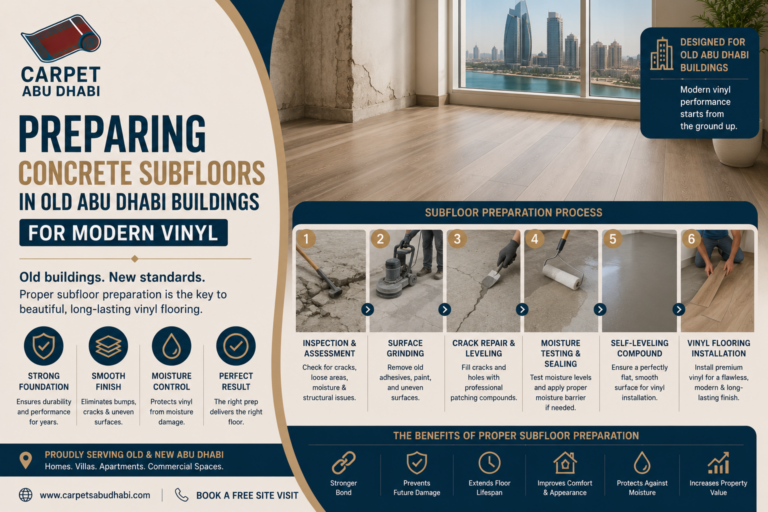
How old office subfloor contaminants affect adhesive for LVT vs wood
Old office subfloors often contain residues from carpet adhesives, leveling compounds, or industrial coatings. These contaminants can significantly reduce adhesion strength for both LVT and wood systems. LVT is generally more tolerant due to flexible adhesive systems, while wood flooring requires cleaner, more stable bonding conditions. Inadequate surface preparation can lead to delamination, hollow spots, or long-term instability regardless of finish quality.
Resale value perception among tenants familiar with both materials
Tenant perception plays a major role in resale and rental value after conversion. Vinyl systems are often associated with durability and low maintenance, especially in high-traffic rental environments. Wood, on the other hand, is perceived as higher-end but requires more upkeep. In markets where tenants have experience with both, value perception depends heavily on condition rather than material alone. Well-maintained vinyl can outperform poorly maintained wood in perceived quality.
Acclimatization windows when converting during winter vs summer
Acclimatization behavior varies significantly depending on seasonal conditions, and this becomes especially important in conversion and refurbishment projects where existing structures are adapted for new uses. In summer, elevated humidity levels cause hygroscopic materials to absorb moisture from the surrounding air before installation, which can extend the required stabilization period.
This allows the material to reach equilibrium moisture content and reduces the risk of post-installation expansion. In winter, the opposite condition occurs: lower ambient humidity encourages materials to release moisture and contract, meaning they must be given adequate time to reabsorb moisture and stabilize before being permanently fixed in place.
In office-to-apartment or mixed-use conversions, overlooking these seasonal differences in acclimatization can lead to long-term performance issues. Once interior environments shift after occupancy, materials that were not properly conditioned may respond to environmental changes with visible movement, such as gapping between boards, surface distortion, or buckling. Proper scheduling of acclimatization based on seasonal conditions is therefore essential to ensure dimensional stability and reduce future maintenance risks.
Which material better hides unevenness from removed office partitions
After partition removal, subfloors often show patchwork levels, fastener holes, or inconsistent screed patches. Vinyl flooring systems—especially thicker or embossed formats—tend to visually mask minor unevenness better than wood, which reflects light more uniformly and highlights imperfections. However, severe unevenness still requires leveling compounds regardless of finish type. The visual forgivingness of vinyl makes it more suitable for rapid post-office conversions where full resurfacing is not always feasible.
Frequently Asked Questions
Can I install LVT directly over old office carpet glue residue?
Yes if residue is fully dry and you apply a primer specifically for contaminated concrete.
Does engineered wood or LVT feel warmer underfoot in converted lofts?
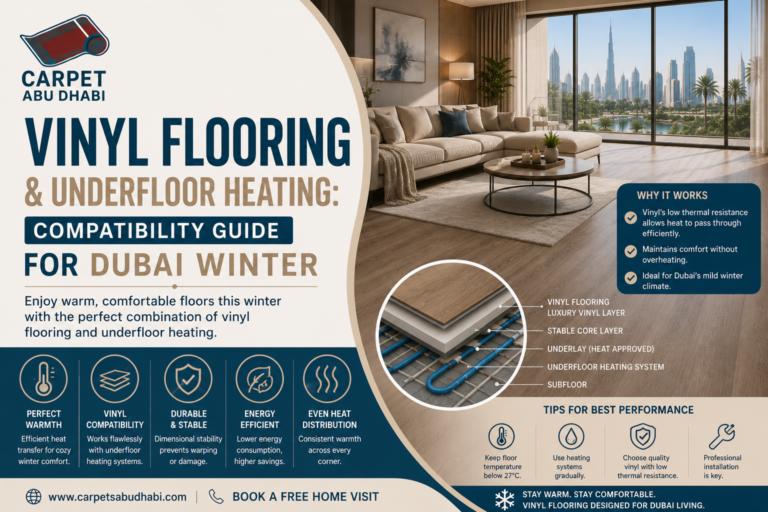
Engineered wood feels warmer; LVT feels cooler but works better with underfloor heating.
Which flooring is quieter when walking in high-ceiling converted units?
Engineered wood on acoustic underlayment is quieter than LVT on foam underlayment.
How do I handle column bases and structural beams with LVT vs wood?
LVT can be heat-molded around curves; wood requires complex coping and scribing.
Will LVT or engineered wood last longer in a converted JLT apartment?
LVT lasts 12-15 years; engineered wood 20-30 years but needs more care.
Can I refinish either flooring type after office-to-apartment wear?
Engineered wood can be sanded 1-3 times; LVT cannot be refinished, only replaced.
Is there a fire safety difference between LVT and wood for converted spaces?
LVT has higher fire rating for Dubai Civil Defence; wood needs additional treatment.
Which material handles furniture rearrangement better in open plans?
LVT handles heavy furniture moves without denting if you use felt pads consistently.
Do banks finance easier for apartments with wood or LVT flooring?
Wood adds more appraised value; LVT is accepted but doesn’t boost valuation as much.