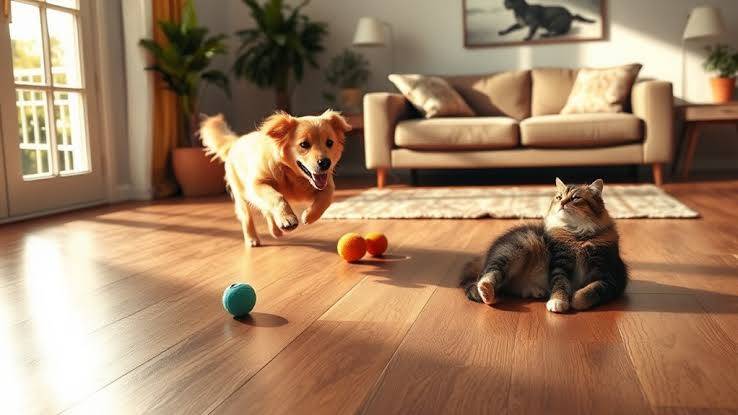
Scratch Resistance Comparisons for Pet-Friendly Homes in JVC help homeowners choose flooring that can withstand daily wear from dogs, cats, and other active pets. In pet-friendly homes in Jumeirah Village Circle (JVC), scratch resistance is a crucial factor that affects both durability and long-term appearance. Comparing different flooring materials allows homeowners to select surfaces that resist claw marks, maintain their finish, and provide a practical, attractive solution for busy households with pets.
Different materials, including luxury vinyl, laminate, engineered wood, and porcelain tiles, vary significantly in their ability to withstand claw marks, furniture movement, and daily wear. In modern JVC residences, homeowners increasingly prioritize flooring solutions that combine aesthetic elegance with high scratch resistance to ensure long-term value and low maintenance.
This comparison explores how various flooring types perform under real-life pet-related conditions, helping residents make informed decisions that balance style, durability, and practicality in busy urban households.
Understanding the Taber abrasion test results in vinyl brochures
The Taber abrasion test measures how resistant a flooring surface is to wear by spinning abrasive wheels over it under controlled pressure. Results are often shown as a number of cycles before visible wear appears. Higher cycle counts generally indicate better abrasion resistance, but the test is comparative—not a perfect real-world predictor. In brochures, manufacturers use it to position products across performance tiers. However, real-life performance also depends on grit, foot traffic patterns, and maintenance, not just lab results.
Thickness of the wear layer needed for large dog breeds
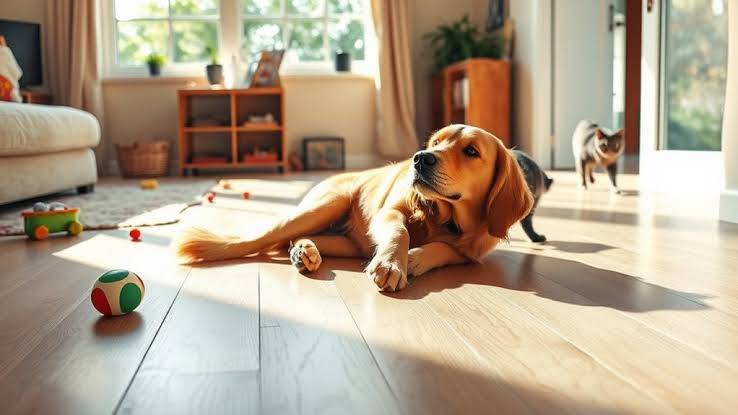
For homes with large dogs, wear layer thickness becomes a crucial factor in maintaining long-term flooring performance, as claws, dirt, and small particles carried indoors act as continuous sources of micro-abrasion. A thicker wear layer, typically found in higher-end residential or commercial-grade vinyl flooring, provides an extended protective buffer that delays damage reaching the decorative surface beneath. However, relying on thickness alone is not sufficient to ensure durability.
The material composition and surface treatment play an equally important role in scratch resistance. Denser wear layers with advanced polyurethane or ceramic bead coatings tend to perform better because they resist both indentation and surface scratching more effectively than softer but thicker alternatives.
In pet-heavy environments, the ideal solution is a balanced combination of adequate wear layer thickness and high surface hardness, ensuring the flooring can withstand constant movement, heavy paws, and abrasive debris without quickly showing visible signs of wear or dullness over time.
How aluminum oxide coating differs from polyurethane protection
Aluminum oxide is a hard mineral additive used to increase surface scratch resistance, especially in engineered flooring and laminate coatings. It significantly improves abrasion resistance but can feel slightly more rigid in finish behavior. Polyurethane, on the other hand, is a flexible protective layer that enhances stain resistance and surface smoothness but is generally less hard. Many modern systems combine both—using aluminum oxide for hardness and polyurethane for flexibility and stain protection.
Scratch hiding ability of embossed-in-register textures
Embossed-in-register (EIR) textures are a key surface technology used in modern flooring to improve the visual realism and scratch camouflage of decorative layers. By precisely aligning the embossed surface grain with the printed wood or stone pattern beneath, EIR creates micro-variations in depth and texture that mimic natural materials more convincingly.
This alignment plays an important optical role: instead of producing a flat, uniform reflective surface where scratches and abrasions are immediately visible, EIR disrupts light reflection across multiple directions. As a result, minor surface scratches tend to blend into the surrounding texture, making them significantly less noticeable in everyday lighting conditions.
However, it is important to understand that EIR is primarily a visual enhancement rather than a structural protection system. It does not actually increase the material’s resistance to scratching. Deep gouges, heavy impacts, or damage that penetrates through the wear layer—such as white-core exposure—will still remain clearly visible regardless of the textured finish.
Comparison between pressed vinyl and poured liquid vinyl durability
Pressed vinyl (sheet or plank-based) is manufactured under controlled heat and pressure, resulting in consistent structure and predictable wear behavior. Poured liquid vinyl (resin-based systems) forms a seamless surface and can offer strong chemical resistance, but performance depends heavily on installation quality. Pressed systems are more standardized, while poured systems are more customizable but sensitive to application conditions like humidity and curing time.
Nail caps and pet paw maintenance to extend floor life
Pet claws are one of the primary causes of surface micro-scratching. Nail caps or regular trimming reduce the mechanical impact on flooring. Smooth, rounded claws reduce pressure points that concentrate force into the wear layer. While flooring hardness is important, behavioral and grooming maintenance significantly extends surface life in pet households. This is especially relevant for glossy or dark floors where scratches are more visible.
Zones most vulnerable to scratches: near balconies and feeding areas
High-risk scratch zones typically include balcony doors, feeding stations, and entry paths. These areas concentrate movement, grit accumulation, and directional dragging from furniture or pet movement. Balcony entrances introduce external sand and dust, which increases abrasion risk significantly. Feeding areas also see repeated motion and occasional spills that soften or attract debris. Targeted protection (rugs or mats) in these zones can significantly reduce long-term wear.
Refinishing options for luxury vinyl with deep pet damage
Luxury vinyl flooring is generally not designed for traditional refinishing like wood. Deep scratches that penetrate the wear layer cannot typically be sanded out. Instead, partial plank replacement or overlay solutions are used. Some surface repair kits can reduce visibility of minor damage, but structural restoration is limited. This is why wear layer selection is critical at installation time, especially in pet-heavy homes.
Warranty fine print about animal-related wear and tear
Most flooring warranties distinguish between manufacturing defects and wear-and-tear damage. Pet-related scratches, dents, or staining are often classified as “normal use” and excluded from coverage. Even products marketed as “pet-friendly” may only cover structural integrity, not surface abrasion from claws. Reading warranty terms carefully is essential, especially regarding exclusions for “damage caused by pets, grit, or improper maintenance,” which are commonly included in fine print.
Frequently Asked Questions
Is there a vinyl floor that resists German Shepherd claws completely?
No floor is scratch-proof, but 0.5mm wear layer with ceramic beads resists 90% of surface marks.
How soon will cheap vinyl show dog scratches in a JVC apartment?
Within 3-6 months with active medium-sized dogs; premium vinyl lasts 3-5 years.
Does lighter or darker vinyl hide scratches better from cats?
Medium tones with multi-color chips hide scratches; dark shows white scratches, light shows dirt.
Can I repair a deep scratch that exposes the printed layer?
Yes with color-matched repair putty and a grain embossing tool; invisible from 1 meter away.
Are rigid core vinyl planks more scratch resistant than flexible ones?
Rigid core (SPC) has harder surface but scratches show more; flexible hides minor scratches better.
What is the most scratch-resistant finish for homes with two Labrador dogs?
Matte finish with 0.7mm aluminum oxide-infused wear layer; avoid high-gloss.
Does the scratch warranty cover damage from my cat running after being startled?
Most warranties exclude animal claws; read “acceptable wear” definitions carefully.
How often should I sweep pet-friendly vinyl to prevent abrasive scratches?
Minimum every two days, ideally daily with a soft dust mop or vacuum without beater bar.
Can I put area rugs on vinyl without trapping moisture that invites scratches?
Yes, but use breathable rug pads and rotate rugs monthly to prevent trapped debris.