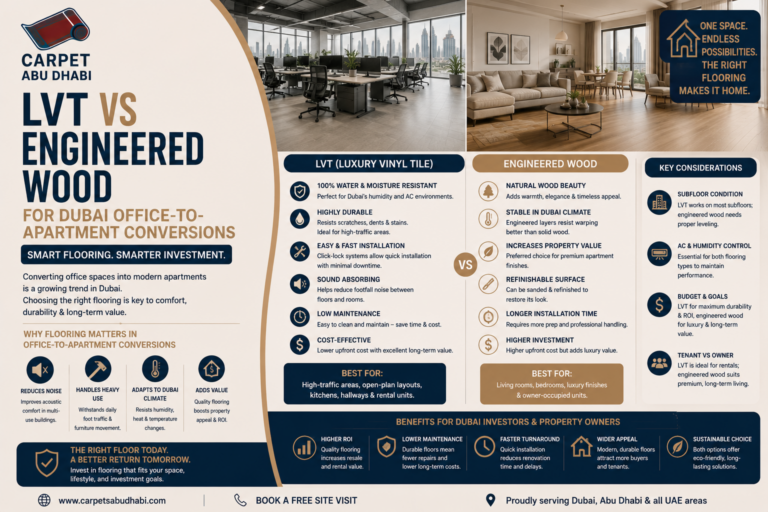
In Abu Dhabi’s villa market, vinyl flooring has become a popular choice due to its durability, water resistance, and design flexibility. However, one of the most important decisions homeowners face is whether to opt for professional installation or attempt a DIY approach.
While DIY installation may appear more cost-effective at first glance, it often comes with hidden risks such as improper subfloor preparation, uneven plank alignment, and reduced long-term performance. On the other hand, professional installation typically involves higher upfront costs but ensures precision fitting, warranty compliance, and optimized lifespan of the flooring system.
In a climate like Abu Dhabi’s—where heat, humidity, and indoor cooling transitions can affect flooring stability—the cost-benefit balance between DIY and professional vinyl installation becomes a critical factor in achieving both aesthetic value and long-term investment protection.
Precision cutting requirements around curved walls and circular staircases
Curved walls and circular staircases are where vinyl installation stops being “layout work” and becomes fabrication work. The main challenge is maintaining a consistent expansion gap while following non-linear geometry without creating visible “flat segments” in the cut line.
Professionals typically use scribing tools, flexible templates, and multi-pass cutting rather than forcing straight cuts into curves. Around stair spirals, each plank often needs individualized shaping, and even small measurement errors accumulate visually across the arc. Poor cutting accuracy in these zones is immediately visible because curves amplify imperfections.
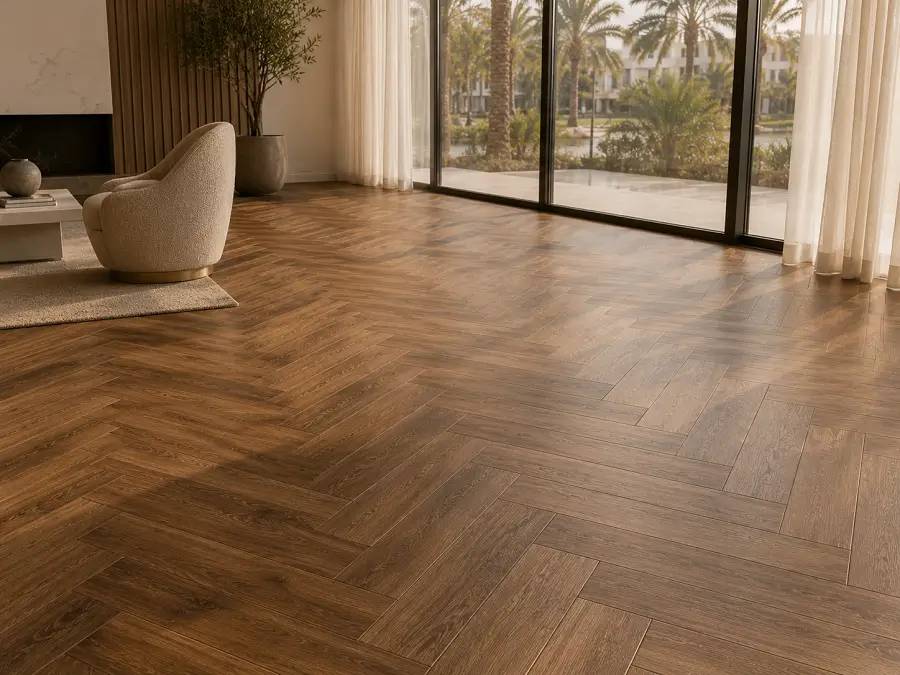
Time savings analysis for 300m² villa installation vs apartment
A 300m² villa installation behaves very differently from a typical apartment job. Villas usually involve multiple rooms, transitions, stairs, and elevation changes, which increase coordination time even if floor area is similar or larger. Apartments, especially open-plan layouts, often allow faster continuous installation runs with fewer interruptions. However, villas benefit from repetition once room patterns are established, while apartments may require more careful alignment over long sightlines. In practice, complexity—not area—drives time more than square meters alone.
Tool investment needed for professional-grade vinyl installation
Professional vinyl installation requires a significantly broader and more specialized toolset than typical DIY work. Beyond basic cutting tools, professionals rely on precision instruments such as laser levels to ensure perfect flatness across large villa spaces and prevent subtle unevenness that can affect long-term performance. Moisture testing equipment is also essential, particularly in environments where humidity or slab moisture can compromise adhesive or click-lock systems over time.
In addition, leveling systems are used to eliminate height variations in the subfloor, ensuring a stable and uniform base before any planks are laid. Seam rollers help secure tight joints and improve adhesion, while undercut saws allow precise trimming around door frames, cabinetry, and fixed architectural elements.
While DIY installations may focus mainly on cutting and fitting, professional results depend heavily on preparation accuracy, measurement control, and surface diagnostics. Ultimately, it is the combination of these tools—not just installation skill—that defines a durable, high-quality vinyl finish.
How subfloor preparation quality differs between DIY and pro
Subfloor preparation is the biggest performance differentiator between DIY and professional work. DIY installations often focus on visible surface readiness, while professionals evaluate moisture content, flatness tolerances, contamination, and structural consistency. Small imperfections that seem minor at installation stage can lead to long-term issues like joint stress or hollow spots. Professional preparation also includes systematic correction rather than localized patching, ensuring uniform support across the entire floor.
Waste factor: DIY overage vs professional optimization
DIY vinyl flooring projects typically require a higher material overage compared to professional installations due to lower cutting efficiency and a greater likelihood of measurement or fitting errors. This becomes especially noticeable in villa layouts with irregular room shapes, angled walls, or multiple transitions between spaces.
Homeowners working without advanced layout planning tools often rely on sequential installation, which can lead to unnecessary waste when mistakes occur or when planks are cut without considering future reuse. In contrast, professional installers use optimized layout planning from the outset, mapping the entire floor area to determine the most efficient plank direction and sequencing strategy.
They also plan cuts in advance to ensure that offcuts are reused in secondary or less visible areas such as closets, utility rooms, or edge zones. For patterned or directional vinyl systems, this optimization is even more critical, as alignment consistency must be maintained while minimizing material loss and ensuring a visually continuous finish.
Warranty implications of self-installation for premium vinyl brands
Many premium vinyl warranties distinguish between material defects and installation errors. Self-installation often reduces warranty coverage because manufacturers cannot control substrate conditions, expansion gaps, or seam integrity. Even if the product is high quality, improper installation can void protection against issues like gapping, buckling, or joint failure. Professional installation is often required to maintain full warranty validity.
How installer insurance covers subfloor damage during fitting
Professional installers typically carry liability insurance that provides coverage for accidental damage that may occur during the installation process. This can include unintended subfloor scoring, damage to adjacent fixtures, or issues arising from improper handling of tools and equipment. In some cases, it may also extend to certain installation-related errors that require corrective work.
However, this protection is not all-encompassing. Insurance policies generally exclude pre-existing substrate conditions, such as cracks, moisture intrusion, or uneven slabs that were present before the project began. Similarly, hidden structural defects uncovered during installation are not considered installer liability unless they are directly caused by the workmanship itself.
As a result, while insurance offers an important layer of financial and legal protection for both homeowners and contractors, it does not replace the need for proper pre-installation inspection and substrate assessment. Understanding these boundaries is essential when evaluating risk in professional vinyl flooring projects.
Acclimatization management in Abu Dhabi summer without pro controls
In hot climates like Abu Dhabi, acclimatization is critical because indoor humidity and temperature swings are extreme during summer. Without professional control, vinyl may expand or contract unpredictably if left in sealed packaging or installed immediately after delivery. Proper acclimatization requires stable indoor conditions for several days, with controlled air-conditioning to balance temperature and humidity before installation begins. Skipping this step increases the risk of post-installation movement.
Resale value perception of professionally vs self-installed floors
Resale perception in the property market is often shaped more by installation quality than by the flooring material itself. Professionally installed vinyl flooring is generally associated with proper subfloor preparation, adherence to manufacturer guidelines, and full warranty compliance, all of which signal long-term durability and reduced maintenance risk.
In contrast, self-installed flooring can sometimes introduce uncertainty for potential buyers or tenants, even if the surface appearance looks visually acceptable. Concerns typically focus on hidden issues such as uneven subfloors, weak adhesion, or improperly locked joints that may not be immediately visible but could affect performance over time.
In high-end rental and resale segments, especially in competitive villa markets, installation credibility becomes a key factor in decision-making. Buyers often interpret professional workmanship as a sign of overall property care, which can positively influence perceived value and negotiation outcomes. As a result, installation quality can play a decisive role in shaping both trust and long-term investment confidence.
Frequently Asked Questions
Does DIY vinyl installation void manufacturer warranty for my villa?
Most brands require professional installation for full warranty; DIY limits to 5-year structural.
What tool does a professional have that DIYers rarely buy?
Vinyl plank sheer cutter for clean cross-cuts and notching around door jambs.
How much more vinyl material does DIY typically waste than professional?
15-20% waste vs professional 5-10% for complex villa floorplans.
Can a DIYer match professional results on concrete with hairline cracks?
No; pros use crack isolation membrane; DIYers skip it, leading to cracked planks within a year.
How long does a professional take for a 150m² villa compared to DIY?
3-4 days pro vs 10-14 days DIY including learning curve and tool adjustments.
Does a professional installer provide a moisture test before starting?
A good one does; if not offered, hire someone else; moisture is #1 vinyl failure cause.
Can I install vinyl myself if my villa has multiple floor height changes?
Not recommended; height transitions are the most common DIY mistake leading to trip hazards.
How much does professional vinyl installation typically cost in Abu Dhabi?
Ask for quotes based on area; expect premium for pattern matching and diagonal layouts.
Do I need building approval for vinyl installation in my Abu Dhabi apartment?
No for same flooring type replacement; yes if changing thickness affects fire door clearance.