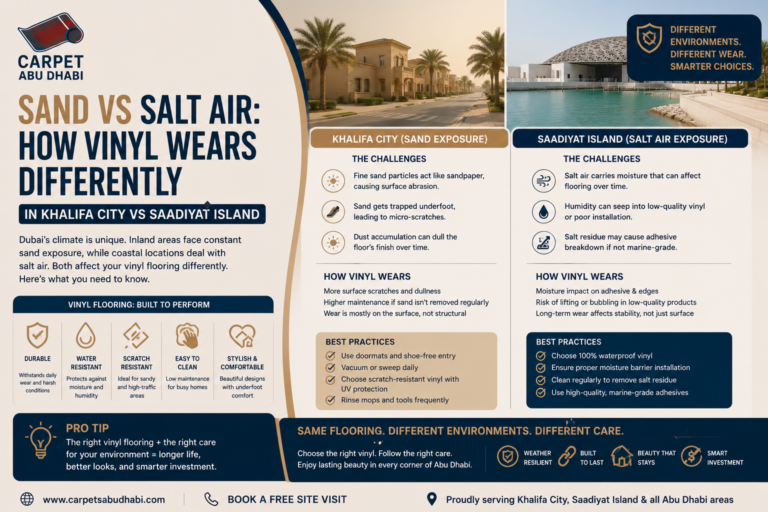
In many older buildings across Abu Dhabi, upgrading flooring systems to modern vinyl finishes requires careful attention to the condition of existing concrete subfloors. These substrates were often constructed under different building standards, resulting in surface irregularities, moisture variability, and inconsistent leveling that can directly affect vinyl performance.
Proper preparation is therefore a critical first step before installation. This includes assessing structural integrity, identifying cracks or weak zones, and addressing residual adhesives or contaminants that may interfere with bonding and adhesion. In addition, moisture testing and surface leveling are essential to ensure long-term stability and prevent issues such as bubbling, gapping, or premature wear.
As vinyl flooring systems become increasingly popular for their durability and aesthetic flexibility, especially in renovation projects, subfloor preparation plays a defining role in achieving a smooth, resilient, and professional finish in older Abu Dhabi properties.
Moisture testing protocols for buildings constructed before 2000
Older buildings—especially those built before 2000 in the UAE—often have no documented vapor control system, so moisture testing becomes essential before any flooring work. The most reliable approach combines surface moisture readings with sub-slab vapor emission testing (rather than relying on surface dryness alone).
Older concrete tends to absorb and release moisture irregularly due to microcracking and long-term exposure cycles. Testing should be done in multiple zones, especially near external walls and bathrooms, because moisture migration is rarely uniform. In practice, older slabs are treated as “unknown-risk substrates” until proven otherwise.
Identifying and treating historical efflorescence salt deposits
Efflorescence appears as white crystalline residue caused by salts migrating through concrete and crystallizing at the surface. In older buildings, it often indicates long-term moisture movement through the slab. Treatment starts with dry mechanical removal (brushing or light abrasion), followed by controlled cleaning to remove residual salts. However, unless the moisture source is addressed, efflorescence will reappear. This is especially common in coastal-influenced environments where humidity and groundwater vapor cycles are persistent.
Patching spalled concrete from decades of humidity exposure
Spalling in older concrete slabs typically results from corrosion of embedded steel reinforcement or prolonged moisture intrusion that weakens the bond between steel and concrete. As corrosion progresses, the steel expands, causing the surrounding concrete to crack, delaminate, and eventually break away from the surface.
Effective repair begins with the complete removal of all loose and unsound material, extending the excavation back to structurally sound concrete rather than just the visible damaged area. This step is critical because surface-level patching often fails to address hidden delamination that can extend beyond what is immediately visible.
Once the substrate is properly exposed and cleaned, suitable bonding agents are applied to ensure adhesion between the existing concrete and the repair material. High-performance repair mortars formulated for aged and moisture-affected substrates are then installed to restore structural integrity. Long-term durability depends primarily on correct substrate preparation rather than the patch material alone itself ultimately.
When to use moisture-mitigation coatings vs vapor barriers
Moisture mitigation coatings and vapor barriers solve different problems. Vapor barriers physically block moisture transmission, typically used beneath flooring systems in new installations or full renovations. Moisture-mitigation coatings are applied to existing slabs where full barrier installation is not possible. These coatings reduce vapor emission rates but do not completely stop moisture movement. In older buildings, the choice depends on whether the floor system is being rebuilt or simply upgraded.
Leveling compounds that bond to aged, oil-stained concrete
Oil-contaminated concrete is one of the most challenging substrates for leveling compounds. Standard self-levelers will fail unless the surface is properly treated with degreasing and mechanical abrasion. Specialized epoxy-modified primers are often required to create a bonding bridge between contaminated concrete and leveling material. Without this step, delamination can occur even if the surface appears stable at installation.
Removing old bitumen-based adhesive residues safely
Bitumen adhesives, common in older flooring systems, are difficult to remove because they soften under heat and smear under mechanical action. Safe removal typically involves controlled grinding or chemical softening agents designed for asphaltic residues. Aggressive scraping alone can damage the slab surface. Proper removal is critical because leftover bitumen can block adhesion of modern flooring systems and cause long-term bonding failure.
Curing time requirements for patches in Abu Dhabi summer heat
High ambient temperatures in places like Abu Dhabi accelerate surface drying but do not always guarantee full internal curing. Rapid surface drying can trap moisture inside patch materials, leading to shrinkage cracks or weak bonding layers. While hot conditions shorten visible drying time, structural curing still requires controlled moisture release. This is why premature installation over “surface-dry” patches is a common failure point in hot climates.
Concrete grinding vs self-leveler for out-of-spec flatness
Concrete grinding is commonly used to remove high points and surface irregularities, while self-leveling compounds are applied to correct low areas and achieve a consistent plane. The appropriate method depends largely on the overall condition of the slab and how it compares to the required installation tolerance.
When the floor has only minor localized high spots, grinding is often the more economical and efficient solution, although it can expose aggregate and may require additional resurfacing to restore a smooth finish. In contrast, self-leveling compounds are preferred when the slab is broadly uneven or when a high degree of flatness is required for modern floating flooring systems such as vinyl.
These compounds flow into depressions and create a continuous, uniform surface once cured. In many renovation projects, especially in older buildings, both techniques are used together—grinding to reduce high points first, followed by self-leveling to fine-tune flatness for optimal long-term performance.
How building age affects expansion joint placement for vinyl
Older buildings tend to have less predictable structural movement due to aging materials, prior modifications, and variable settlement. As a result, expansion joints in vinyl installations must be more conservatively designed. Joint placement often increases near transitions, long spans, and areas where slab sections meet. Unlike modern structures with predictable movement zones, older buildings require more flexible design assumptions to prevent buckling or joint separation over time.
Frequently Asked Questions
How long after concrete pouring in an old building can I install vinyl?
Minimum 60 days drying time plus calcium chloride test below 3 lbs per 1000 sq ft.
What does white powder on my old concrete floor mean for vinyl?
Efflorescence (salt migration); must be ground off and sealed before vinyl installation.
Can I install vinyl over concrete that had termite treatment holes?
Yes after filling holes with epoxy patch and testing for residual moisture traps.
Do old Abu Dhabi slabs need different primer than new construction?
Yes, high-absorption primer for aged concrete; standard primer works for sealed surfaces.
How flat must an old subfloor be for large-format vinyl planks?
3mm over 2 meters; older slabs often need grinding or self-leveling compound.
Is it safe to grind old concrete indoors without dust control?
No; use shrouded grinder with HEPA vacuum to avoid breathing silica dust.
What is the fastest way to dry an old slab in Abu Dhabi summer?
Run dehumidifiers and increase AC to 24°C for 7-10 days minimum before testing.
Can existing ceramic tiles in an old apartment serve as subfloor for vinyl?
Yes if tiles are fully bonded and you add 2mm uncoupling membrane for cracks.
How do I check for hidden hollow spots under old concrete before vinyl?
Tap with metal rod; hollow drum sound means potential crack zone needing repair.